
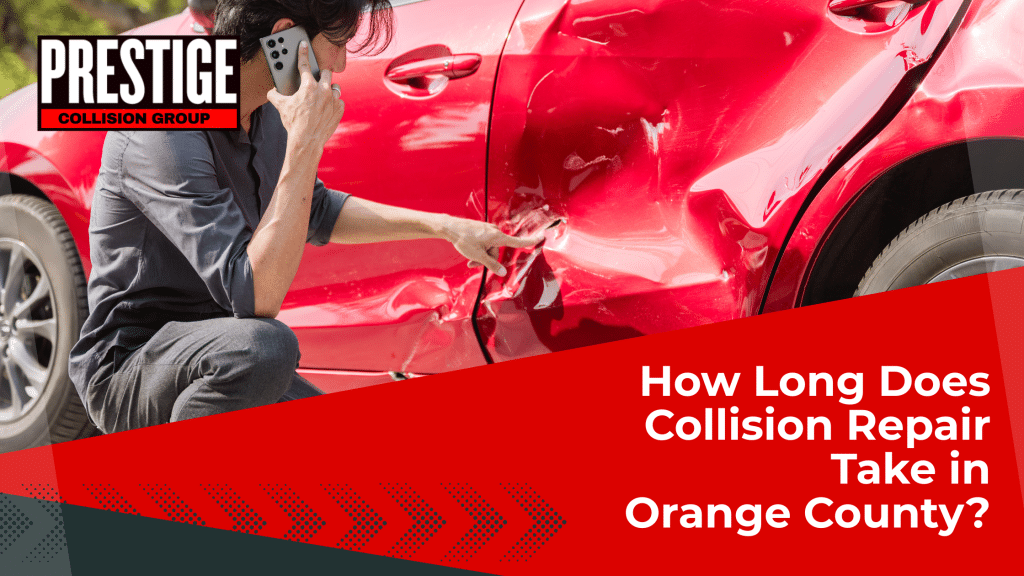
After a car accident, one of the first questions most drivers in Orange County ask is simple:
“How long is this going to take?”
Whether your vehicle was damaged in Mission Viejo, Irvine, Lake Forest, Anaheim, or anywhere in Orange County, CA, collision repair timelines can vary widely. Some vehicles are repaired in a few days. Others may require several weeks.
Understanding what impacts the repair timeline helps you plan for rental coverage, work commutes, and family transportation. It also helps you recognize the difference between normal repair time and unnecessary delay.
This guide breaks down realistic auto body repair timelines in Orange County, explains what affects repair speed, and answers the most common questions drivers have after an accident.
Average Collision Repair Timeline in Orange County, CA
Repair time depends largely on the severity of the damage. Below is a realistic breakdown based on industry standards and local repair patterns.
Minor Cosmetic Damage (3–5 Business Days)
Examples include:
- Small dents
- Scratches and paint damage
- Minor bumper repairs
- Single panel replacement
These repairs typically do not involve structural damage. Once parts are available and insurance approval is granted, work can move quickly.
Moderate Collision Damage (1–2 Weeks)
Moderate repairs may include:
- Multiple damaged panels
- Suspension component replacement
- Airbag replacement
- Paint blending across several panels
These repairs require more labor hours, additional parts, and detailed refinishing work.
According to the Insurance Information Institute, the average collision claim exceeds $5,000 nationwide. Claims at this level typically involve multi-step repairs that take longer than minor cosmetic fixes.
Major Structural Damage (2–4+ Weeks)
Severe accidents may involve:
- Frame straightening
- Structural component replacement
- ADAS recalibration
- Extensive disassembly
- Specialty parts ordering
Structural repairs must follow manufacturer safety standards. The Insurance Institute for Highway Safety emphasizes that proper structural restoration is critical to maintaining crash protection in future accidents.
These repairs cannot and should not be rushed.
What Actually Affects Collision Repair Time?
Many drivers assume repair delays are caused by the shop alone. In reality, multiple moving parts influence the timeline.
1. Insurance Approval Process
Before work begins, insurance companies must:
- Review the repair estimate
- Approve labor hours
- Approve parts pricing
- Confirm coverage limits
If hidden damage is discovered during disassembly, a supplemental estimate must be submitted and approved before work continues.
Professional insurance claim management can help streamline communication between your repair facility and insurance adjuster, reducing unnecessary back-and-forth delays.
2. Hidden Damage After Disassembly
One of the most common timeline extensions happens after technicians begin disassembly.
Modern vehicles are designed to absorb impact in controlled ways. Damage may extend far beyond what is visible externally.
Once panels are removed, technicians may find:
- Bent structural supports
- Damaged brackets
- Sensor displacement
- Cracked mounting points
When additional damage is discovered, insurance must approve supplemental repairs.
While this adds time, it protects your safety and ensures your vehicle is properly restored.
3. OEM vs Aftermarket Parts
Parts sourcing significantly impacts repair speed.
OEM Parts
Original Equipment Manufacturer parts are built by your vehicle’s manufacturer to exact specifications.
Choosing a shop with OEM certification ensures repairs follow factory-approved standards.
However, OEM parts may require special ordering, especially for newer models.
For manufacturer repair procedures, you can reference:
Toyota Technical Information System (https://techinfo.toyota.com)
Honda Service Information (https://techinfo.honda.com)
Aftermarket Parts
Aftermarket parts are produced by third-party manufacturers and are sometimes more readily available. However, fitment adjustments may occasionally be required.
Availability depends on vehicle type, market demand, and supply chain conditions.
4. Frame Straightening & Structural Repairs
Structural damage requires precise measurement and correction using computerized frame systems.
Professional collision repair services use manufacturer repair data to restore frame dimensions accurately.
Structural repairs often take additional time because:
- Measurements must be exact
- Pulling and correction require incremental adjustments
- Post-repair verification is mandatory
Skipping these steps compromises vehicle integrity.
5. ADAS Calibration
Most vehicles in Orange County now include Advanced Driver Assistance Systems (ADAS) such as:
- Lane departure warning
- Adaptive cruise control
- Blind spot monitoring
- Automatic emergency braking
After a collision, these systems often require recalibration.
Calibration may require:
- Specialized equipment
- Manufacturer software
- Controlled lighting environments
This process adds time but ensures safety systems function correctly.
6. Paint & Refinishing Process
Auto body repair is not just about replacing panels.
Refinishing involves:
- Surface preparation
- Sanding and priming
- Base coat application
- Clear coat application
- Controlled curing
- Color blending
- Final polishing
Professional auto body repair services focus on seamless paint matching and long-term durability.
Paint curing alone requires specific time intervals to ensure proper adhesion and finish quality.
The Cost vs Timeline Balance
Many drivers ask if repairs can be done faster.
Speed is important. Safety is more important.
Rushed repairs can result in:
- Improper panel alignment
- Paint defects
- Missed structural reinforcements
- Incomplete ADAS calibration
In Orange County, CA, shops that follow strict OEM standards may require slightly longer timelines. However, those additional days often translate into safer and longer-lasting repairs.
A Realistic 2-Week Repair Example
Here is a typical moderate repair timeline:
Day 1–2: Estimate and insurance approval
Day 3–4: Parts ordered
Day 5–7: Structural and body repair
Day 8–10: Paint and curing
Day 11–12: Reassembly
Day 13–14: Calibration and quality inspection
This example assumes no major parts delays.
Keep in mind that every vehicle and accident is different. Some repairs may move faster if parts are in stock and no supplemental damage is found. Others may take longer if additional structural issues are discovered during disassembly. Quality control inspections and system calibrations are especially important in modern vehicles equipped with advanced safety features. While two weeks is common for moderate damage in Orange County, clear communication with your repair facility will give you the most accurate timeline for your specific situation.
How to Minimize Delays
Drivers can help reduce downtime by:
- Reporting claims immediately
- Providing complete documentation
- Choosing a certified repair facility
- Approving repairs promptly
- Staying responsive to communication
Being proactive can significantly shorten your collision repair timeline in Orange County. The faster your insurance company receives accurate information, including photos, police reports, and vehicle details, the faster approvals can move forward. Delays often happen when paperwork is incomplete or authorization decisions are postponed.
It’s also helpful to confirm rental coverage early and plan alternate transportation just in case parts ordering takes longer than expected. Staying in regular contact with your repair advisor ensures you receive updates and can quickly respond if supplemental approvals are needed.
If your vehicle has been damaged, you can start the process by requesting a free estimate here:
Get a Free Estimate
Frequently Asked Questions (FAQs)
Q: How long does collision repair take in Orange County, CA?
A: Minor repairs take 3–5 days. Moderate damage usually takes 1–2 weeks. Severe structural repairs may take 2–4 weeks or longer.
Q: Why is my auto body repair taking longer than the original estimate?
A: Hidden damage discovered during disassembly and insurance supplemental approvals are the most common reasons for extended timelines.
Q: Do parts shortages affect repair times in Orange County?
A: Yes. OEM parts, specialty components, and newer vehicle parts may require additional ordering time.
Q: Can I drive my vehicle while waiting for parts?
A: Only if a professional determines it is safe. Structural or sensor damage may make driving unsafe.
Q: Does choosing an OEM-certified shop take longer?
A: Not necessarily. OEM-certified shops follow manufacturer procedures that prioritize safety and quality.
Q: How long does insurance approval take for collision repair in Orange County?
A: Insurance approval can take anywhere from 1–5 business days, depending on the complexity of the claim, adjuster availability, and whether supplemental damage is found.
Q: What is a supplemental estimate in collision repair?
A: A supplemental estimate is an additional repair request submitted to insurance after hidden damage is discovered during disassembly. This approval process can extend the repair timeline.
Q: Will rental car coverage last the entire repair process?
A: Rental coverage depends on your individual insurance policy. Some policies cover a set number of days or a maximum dollar amount, so it’s important to confirm limits with your provider early in the repair process.
Final Thoughts: Transparency Matters
Collision repair in Orange County, CA, is not a one-size-fits-all process. Timelines depend on damage severity, parts availability, insurance approval, and manufacturer repair standards.
While waiting can be frustrating, proper repairs protect your safety, vehicle value, and long-term reliability.
It’s important to remember that your vehicle is engineered with precise safety systems designed to perform a certain way in future accidents. Cutting corners or rushing the process can compromise structural integrity, sensor performance, and even airbag deployment timing. A thorough repair ensures your car not only looks good again, but performs the way it was originally designed to.
Clear communication from your repair facility should include timeline updates, parts tracking, and transparency if delays occur. You deserve to know what stage your vehicle is in and what comes next.
If you want clear communication and realistic expectations throughout your repair process, contact Prestige Collision Group today to schedule your estimate and get your vehicle safely back on the road with confidence.
